
-scaled-1.png)
Trend of China’s tire exports in the next 5 years
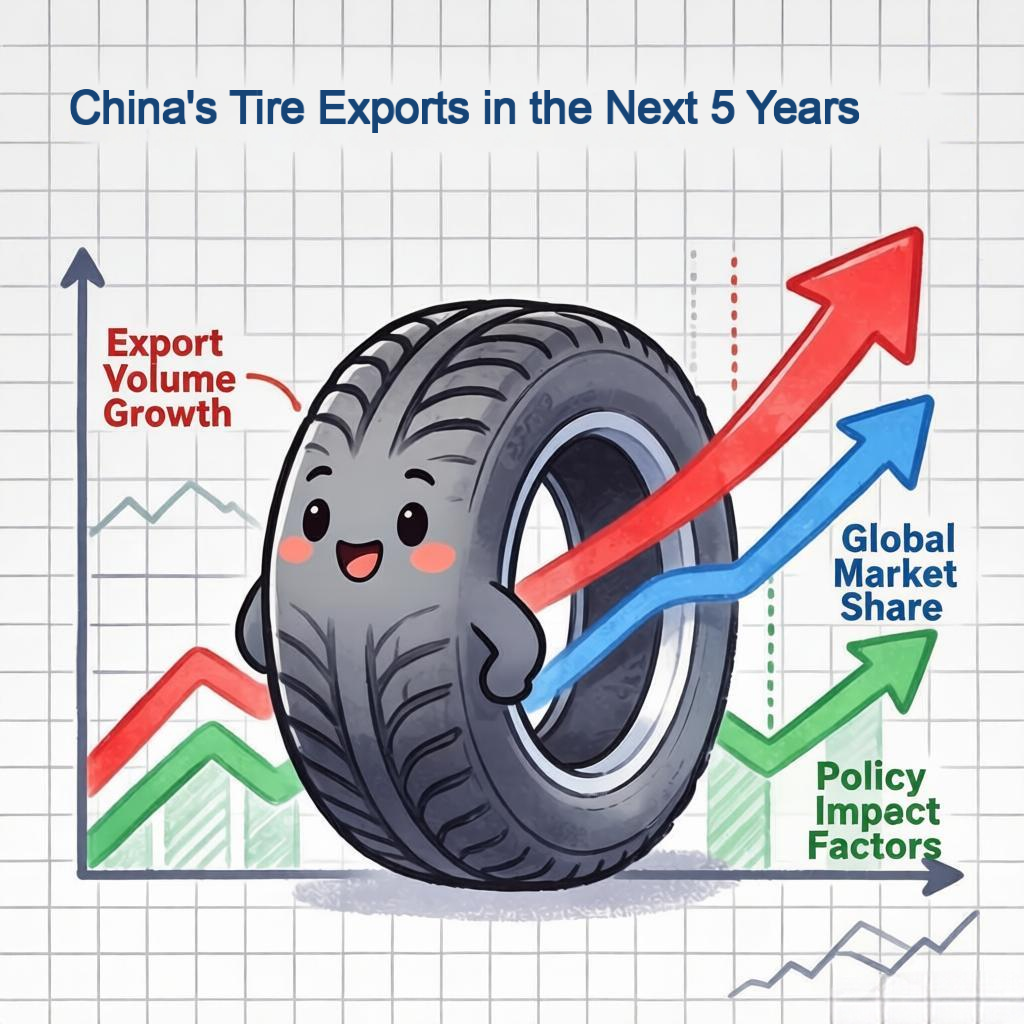
China tire exports are facing dual pressures of increasing volume and decreasing prices, as well as trade barriers, but the key to breakthrough lies in the layout of emerging markets and technological upgrades.
The total export volume is steadily increasing, but the growth rate is slowing down
In the first quarter of 2026, the export volume of new inflatable rubber tires from China reached 1.9434 million tons, a year-on-year increase of 4.04%; The export value was 4.519 billion US dollars, a slight increase of 0.38% year-on-year. Despite the increase in volume, the average price has decreased by 3.51% year-on-year, showing a “price drop” characteristic, reflecting the intensification of international market competition and price war pressure.
Comprehensive tightening of trade barriers puts pressure on major markets
EU: The final anti-dumping ruling is expected to be implemented in June 2026, coupled with the R117-04 technical regulation (mandatory localized production and high environmental standards), which will significantly increase the entry threshold.
The United States: In the first two months of 2026, the number of imported tires from China plummeted by 29%, and passenger tires plummeted by 32%, with continued pressure.
Russia: Although it is the largest single export market (with an export value of 233 million US dollars in Q1 2026), the doubling of environmental taxes, extension of anti-dumping measures, and pressure from local enterprises have compressed its survival space.
Latin America: Peru and Brazil have successively launched anti-dumping investigations, and protectionism is on the rise in the South American market.
Market structure differentiation, emerging markets become growth engines
RCEP region: exports to ASEAN, South Korea and other countries have grown rapidly, with exports to RCEP countries increasing by 20.68% year-on-year in Q1 2026, and Myanmar’s growth rate reaching as high as 87.75%.
Africa and Eastern Europe: Africa’s exports increased by 13.55% year-on-year, while South Africa’s reached 40.71%; Eastern Europe grew by 25.60%, mainly benefiting from the replacement demand in the Russian market.
Latin American relay growth: Exports to Brazil surged by 50.74%, benefiting from tariff adjustments and replacement demand brought about by aging cars.
Product structure optimization, all steel tire support for export toughness
All steel tires (TBR): Production will increase by 7.19% year-on-year in 2025, with exports mainly targeting regions with strong demand for commercial vehicles such as Latin America and the Middle East.
Semi steel tires (PCR): Affected by the EU’s “double reverse” policy, export growth will be weak in 2025, and the operating rate in the second half of the year will be insufficient.
Looking ahead to 2026, there is still room for incremental demand for all steel tires, but the growth rate will narrow to about 1%, constrained by high export bases and inventory pressure.
Future industrial transformation direction: localization+technological upgrading
Relying solely on low-cost export models is no longer sustainable. Enterprises need to accelerate the establishment of factories in Southeast Asia, the Middle East, and other places to achieve localized production, and improve product technology to meet high-end standards in Europe and America, shifting from “price competition” to “value competition”.
We have established strategic partnerships with multiple top-tier tire manufacturers both domestically and internationally, offering over 2000 SKUs of tire products.
You cancontact us for any inquiries related to tires, wheel hubs, and automotive parts.
relying on a comprehensive supply chain system and global layout to provide overseas customers with a full range of tire products and customized solutions.
For related products, please proceed to the product section.